

Spring Workshop for Women Researchers in Engineering: Practical Guidance on Research Proposals and Career Support
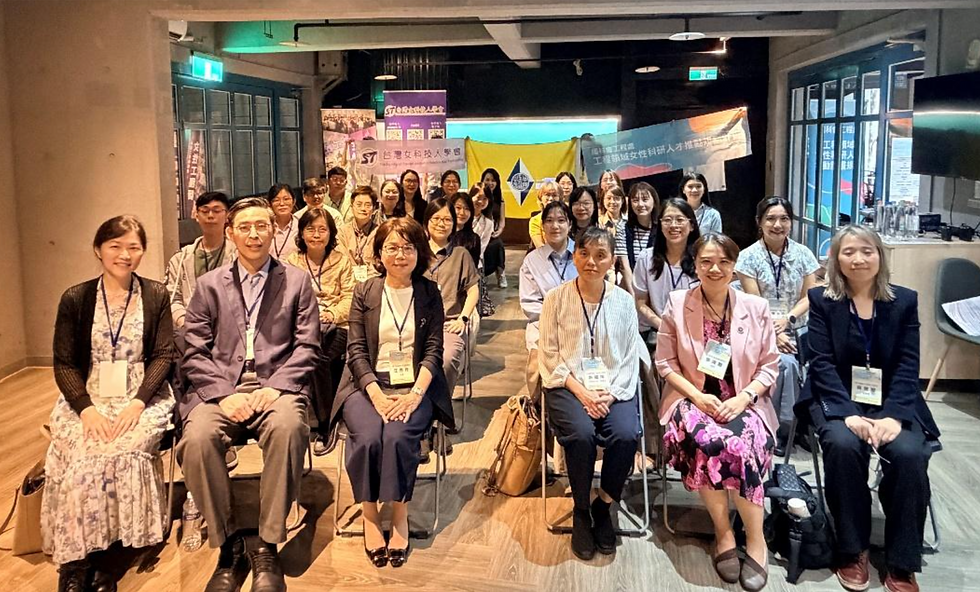
[TWiST News] The Spring Practical Workshop of the Program to Support Women Researchers in Engineering, jointly organized by the Department of Engineering and Technologies of Taiwan’s National Science and Technology Council, the Taiwan Women in Science and Technology Association (TWiST), and the Women Engineers Committee of the Chinese Institute of Engineers, was held on May 14, 2026, at the Hakka College Lounge of National Yang Ming Chiao Tung University. Centered on the theme “How Can You Win Research Funding? Unlocking the Essentials,” the workshop focused on the practical skills involved in writing and applying for research grants, helping participants identify key considerations for both individual and integrated research proposals.
The event was held in a hybrid format. Thirty-seven people attended in person—31 women and 6 men—and approximately 40 joined online. Program convener Professor Hsiao-Wen Zan of NYCU’s Department of Photonics opened the workshop. Dr. Chao-Ping Hsu, President of TWiST, and Hsiu-Tan Chiang, Chair of the Women Engineers Committee of the Chinese Institute of Engineers, also delivered remarks to welcome participants.
The morning program began with practical guidance on research grant applications. Professor Kea-Tiong Tang of National Tsing Hua University’s Department of Electrical Engineering presented “Individual Research Projects: What Adds or Subtracts Points?” Drawing on his own application experience and knowledge of the review process, Professor Tang emphasized that a strong proposal must do more than describe the intended research. It should also clearly demonstrate the significance of the topic, provide a compelling motivation, present a thorough literature review, and set out a concrete and feasible methodology.
The second talk, “Integrated Research Projects: Team Participation vs. Individual Contribution,” was delivered by Professor Wei-Li Hsu of National Taiwan University’s School and Graduate Institute of Physical Therapy and Center for Artificial Intelligence and Advanced Robotics. Professor Hsu traced her path from joining research teams and serving as a co-principal investigator to gradually building experience and leading integrated projects. She explained how early-career researchers can develop visibility and research networks within academic communities. She also noted that an integrated project should not simply place several subprojects side by side; it must clearly show how the subprojects support one another, how data flows between them, how methods connect, and how the collaboration produces shared outcomes over time.
Following the two morning talks, Professor Ya-Yu Chiang moderated a panel discussion in which the speakers responded to questions about research grant applications and academic careers. The conversation covered networking, professional visibility, time management, academic service, and knowing when to say no, while giving participants an opportunity to raise practical challenges they had encountered during the application process.
The afternoon session, “Pause, Regroup, and Move Forward: Strategies and Practical Tips,” featured Professor Wan-Jen Huang of National Sun Yat-sen University’s Institute of Communications Engineering and Professor Li-Yin Chen of NYCU’s Department of Photonics. They discussed how to navigate disappointment when a proposal is not funded, appeals, gaps in funding, and the practical management of laboratories and students. They reminded participants that an unsuccessful application does not indicate a lack of personal ability; it can also create an opportunity to reassess the value of the research, take stock of available resources, and adjust direction.

The final session, “Candid Answers: Questions and Discussion,” was moderated by Professor Yi-Kuei Lin of NYCU’s Department of Industrial Engineering and Management. Questions collected in person and through Slido addressed practical concerns about research grant applications, including the NSTC Young Scholar Fellowship Program, the composition of review panels, switching academic disciplines, applications for individual research projects by faculty at universities of science and technology, selecting a research topic when moving from industry to academia, and persuading reviewers when extensive preliminary results are not yet available.
Through keynote talks, panel discussions, and an open question-and-answer session, the Spring Practical Workshop addressed common challenges in the research grant application process. It also created opportunities for women researchers to exchange experiences, share career perspectives, and build supportive networks. From individual and integrated research projects to regrouping after an unsuccessful application, the program highlighted the challenges researchers may face at different career stages and the preparations that can help them move forward.


Comments