

“Balancing Multiple Roles: Practical Advice for Researchers” - Highlights from the 2025 Spring Workshop

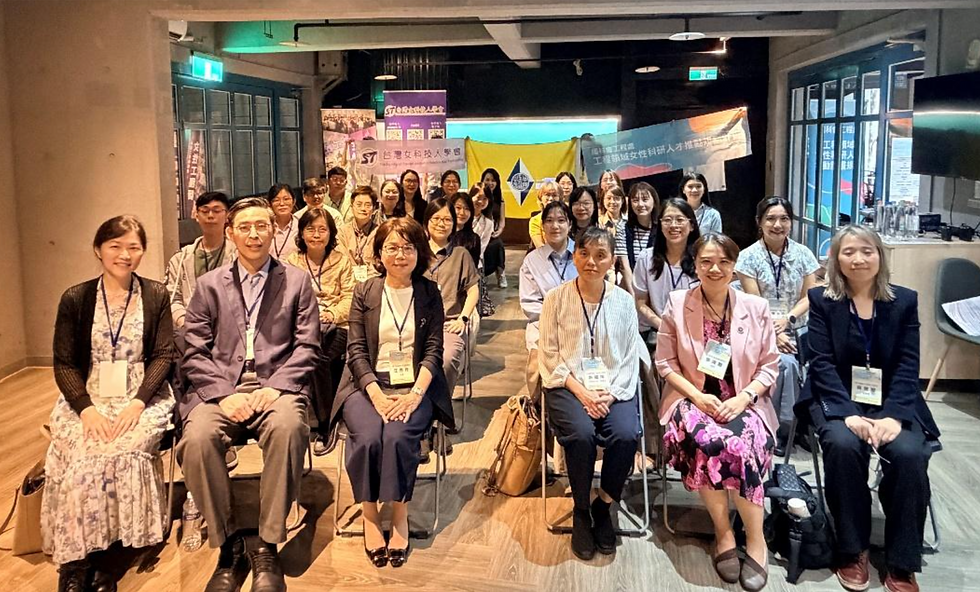
On May 29, 2025, a meaningful workshop took place at the Applied Science and Technology Building of National Chung Hsing University (NCHU). It was the first event under the NSTC Department of Engineering and Technologies’ Women Researchers in Engineering Advancement Program.
The workshop was jointly organized by the NSTC Department of Engineering and Technologies, the NCHU College of Engineering Women’s Committee, the Taiwan Women in Science and Technology Association (TWiST), and the Women Engineers Committee of the Chinese Institute of Engineers, with support from the NSTC Engineering Research Promotion Center. It attracted 75 in-person and 100 online participants.
The workshop was made possible through the strong support of the NCHU College of Engineering Women’s Committee. Established three years ago by Dean Ming-Der Yang, the committee has developed a strong organizational structure and organized numerous activities. Professors Chia-Yin Chen and Hui-Ping Tsai coordinated with project convener Professor Hsiao-Wen Zan to plan the program, while NSTC coordinator Hui-Hsien Lo assisted with correspondence and external communication. I was also fortunate to participate behind the scenes as an observer and recorder.
The event opened with remarks from NCHU Vice President for Research and Development Jenn-Ming Song and project convener Hsiao-Wen Zan of National Yang Ming Chiao Tung University. Song discussed NCHU’s gender-friendly policies and support for women scholars. Zan noted that women have long represented a low proportion of principal investigators in engineering. The project therefore aims to overcome structural barriers, encourage practical exchanges, and build a gender-inclusive research environment.
The workshop, titled “Balancing Multiple Roles: Practical Advice for Researchers,” featured NCHU College of Engineering Dean Ming-Der Yang and Distinguished Professor I-Son Ng from National Cheng Kung University’s Department of Chemical Engineering. Through a presentation and discussion, they shared practical experiences in research, life, and career development.
Dean Yang opened with a talk titled “She Is Outstanding—She Just Doesn’t Say It.” Drawing on statistics and personal observations, he explained that women remain underrepresented in engineering and research, leaving considerable room for future growth in STEM participation.
He also discussed interdisciplinary collaboration and team leadership. When applying for research funding or awards, researchers must clearly communicate what they have accomplished and why it matters. He summarized this approach in four principles: precise problem definition, advanced technology, simplifying complexity, and extending value. Researchers should demonstrate technical ability while clearly explaining their work’s social value and future potential. He also noted that increasingly accessible AI tools may create new opportunities for women in technology. He concluded with an encouraging message: “She is outstanding—and she wins awards.”
Professor I-Son Ng then presented “Navigating Multiple Roles: How Researchers Can Balance Life and Work.” She shared how she balances her responsibilities as a teacher, mother, and researcher, reflecting on her education, teaching career at Xiamen University, return to Taiwan, and experience guiding students in the international iGEM competition.
Ng introduced her 3/3/3 principle, which divides time among important, necessary, and leisure activities. She encouraged early-career researchers to use small blocks of time effectively and actively build professional connections to sustain their research momentum. Drawing on her experience writing research proposals, she also emphasized that a well-developed topic, clear methodology, and measurable outcomes are essential to a successful application.
The presentations by Professors Yang and Ng were both thoughtful and inspiring. Their experiences offered valuable guidance on research strategies, career development, and work–life balance. Participating in and documenting this workshop as a student was a valuable learning experience. It deepened my understanding of how institutional support and professional networks shape research environments and strengthened my hopes for a more collaborative and gender-inclusive future.
Author: Fang-Yu Wu, Graduate Student, International College of Semiconductor Technology, National Yang Ming Chiao Tung University


Comments